
In the world of graphic lamination, we use technical terms every day that are commonplace for industry professionals but don’t always mean the same thing to everyone.
That’s why, at TAULER, we’re launching our Lamination Glossary—a series of articles designed to explain, in simple terms, some of the most commonly used concepts in the lamination process.
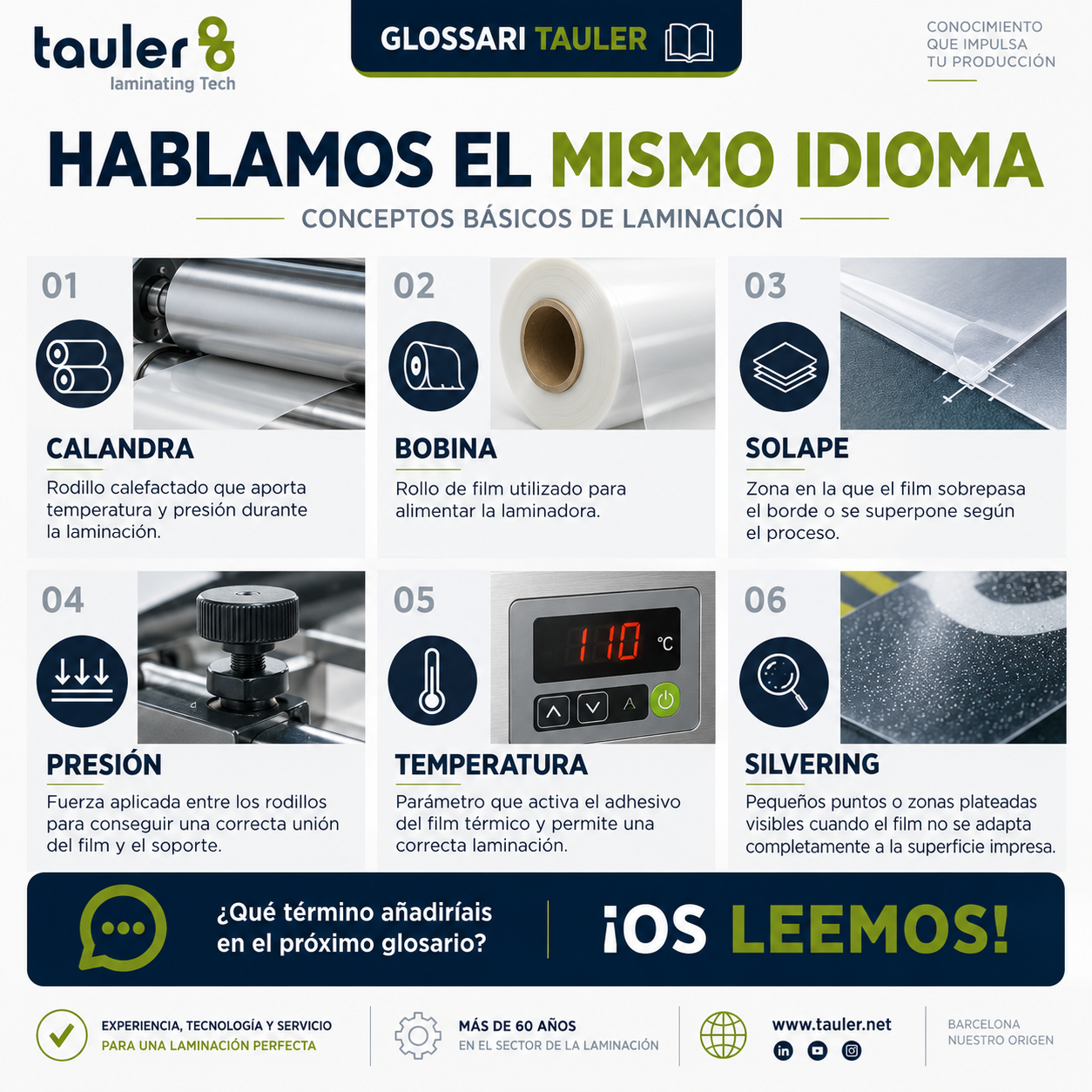
We’re starting with six basic terms: calender, roll, overlap, pressure, temperature, and silvering.
- Calender
The heating roll is the heated roll that provides heat and pressure during rolling.
This is one of the fundamental elements of the process, as it helps ensure a proper bond between the film and the printed substrate. Its configuration must be adapted to the characteristics of the material and the job being performed.
- Reel
The reel is the roll of film used to feed the laminator.
The type of film chosen will depend on the application, the desired finish, and the characteristics of the final product. Materials such as BOPP or PET may behave differently depending on the specific job.
If you’d like to learn more about the differences between them, check out our comparison of PET vs. BOPP for lamination. - Overlap
The overlap is the area where the film extends beyond the edge of the substrate or overlaps it, depending on the process used.
Proper control of this area is important for achieving a clean finish and avoiding problems during subsequent stages of production or handling of the rolled product. - Pressure
Pressure is the force applied between the rollers to ensure a proper bond between the film and the substrate.
Along with temperature and speed, it is one of the essential parameters of the process. Proper configuration ensures consistent contact and results in uniform rolling. - Temperature
Temperature is the parameter that activates the adhesive on the thermal film and ensures proper lamination.
The required temperature may vary depending on the type of film, the substrate, the inks used, and the production speed. That is why it is important to find the right balance for each job.
- Silvering
Silvering is one of the defects that can occur during lamination. It is identified by the presence of small silvery spots or areas that are visible when the film does not fully adhere to the printed surface.
Its occurrence may be related to various factors in the process, so properly controlling the rolling parameters is essential to minimize it.
A Common Language for Better Lamination
Understanding these concepts facilitates communication among professionals and helps provide a better understanding of what happens during each stage of the process.
At TAULER Laminating Tech, we continue to share technical knowledge to help achieve more efficient, reliable, and controlled lamination processes.
This is just the first chapter of our Laminating Glossary. You can also check out the original post on LinkedIn.
.


