
In graphic lamination, choosing the right film is just as important as using the right equipment and settings.
At first glance, materials such as PET and PP (BOPP) may seem very similar, but their properties and behavior during lamination differ significantly.A simple vista, materiales como el PET y el PP (BOPP) pueden parecer muy similares, pero sus propiedades y comportamiento durante la laminación presentan diferencias importantes.
Understanding these factors allows you to choose the most appropriate option based on the type of job, the desired finish, and the requirements of the final product.
What is PP or BOPP film?
PP (polypropylene), commonly used in its BOPP form—biaxially oriented polypropylene—is one of the most widely used films in the graphic arts industry.
Its popularity is mainly due to its versatility, light weight, and good balance between performance and cost. These characteristics make it a suitable solution for a wide variety of lamination jobs, especially in production settings where a high-quality finish is desired while maintaining high efficiency.
In addition, its flexibility makes it easy to adapt to a wide range of graphic applications and types of printed materials.
What are the characteristics of PET film?
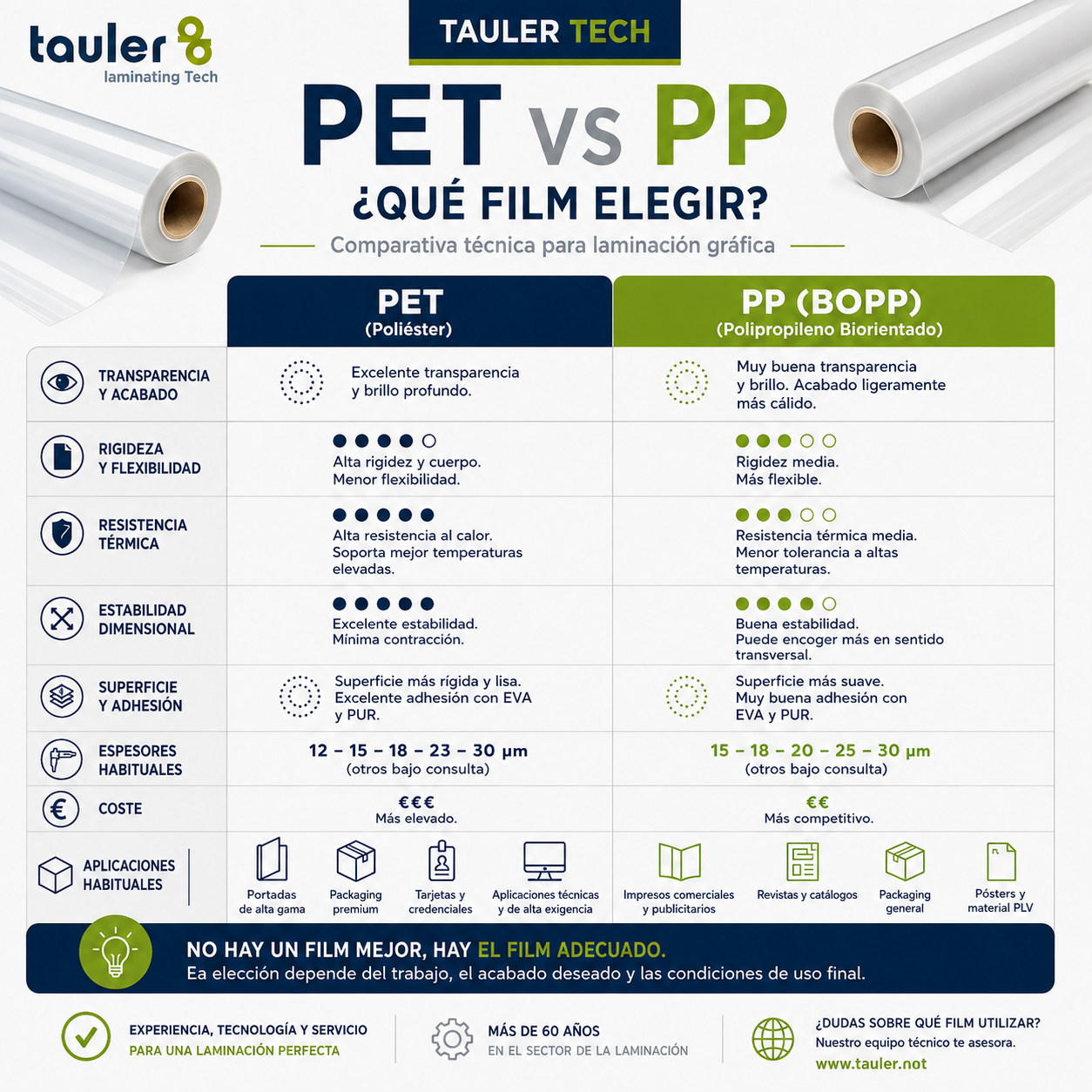
PET (polyethylene terephthalate) is particularly notable for its greater rigidity, dimensional stability, and heat resistance.
These properties can be particularly beneficial when the laminated product requires greater consistency or must withstand more demanding conditions.
Compared to BOPP, PET feels stiffer and more stable, making it an alternative worth considering for certain applications where the material’s mechanical properties are a key factor.
PET vs. BOPP: Key Differences
Although there is no single film that is best for all applications, there are certain characteristics that can help you make a decision.
BOPP
● Greater lightness and flexibility.
● Excellent balance between performance and cost.
● Great versatility for graphic lamination projects.
● One of the most widely used options in the industry.
PET
● Greater rigidity.
● Improved dimensional stability.
● Greater resistance to high temperatures.
● Suitable for applications that require greater material consistency.
Which film should you choose for lamination: PET or BOPP?
The answer will always depend on the end use.
If you’re looking for versatility, lightness, and efficiency in everyday graphic design work, BOPP can be an excellent choice. On the other hand, when you need greater rigidity, stability, or heat resistance, PET can offer additional advantages.
The choice of film should be part of the set of decisions that determine high-quality professional lamination, along with factors such as temperature, pressure, processing speed, the substrate used, and the characteristics of the laminator.
At TAULER Laminating Tech, we work to provide efficient, reliable lamination processes tailored to the needs of the graphic arts industry. You can explore our line of professional laminators or check out this comparison within our TAULER TECH series.
Because choosing the right film is also part of a good lamination process.


